
Cannabis Basket Update
Some background on my cannabis basket

Disclosure: I own shares in several of the companies discussed below. This is not investment advice. Cannabis remains a volatile and highly speculative sector. Please do your own work.
Please note that I wrote this over several days so some numbers may not be exact.
Nobody does bubbles quite like us Canadians. I vividly remember a few things with cannabis in 2017/18.
Back when I had a day job, many floor workers wanted to talk stocks. 90%+ would tell me to buy cannabis. I would ask how much money to you think (insert company) will make. It was always responded with a “doesn’t matter, once it’s legal things will work out”.
Being at a microcap conference in a hotel (can’t remember specifically which one) and Aurora Cannabis had their AGM at the same time. The AGM was so well attended that they needed two auditoriums for attendees, and they had what I always referred to as “beer tub girls” guiding attendees to their seat.
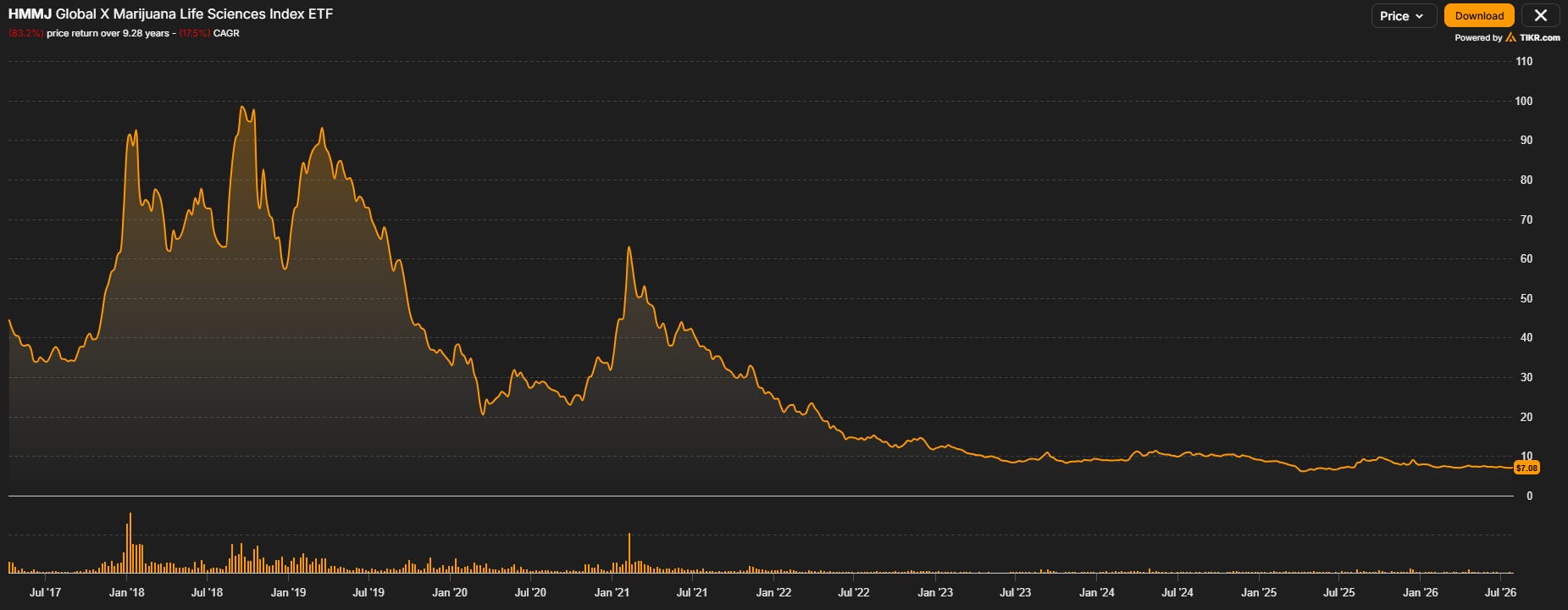
Here is the HMMJ (the Canadian cannabis ETF) since inception, it’s down 83%. And down 93% from the peak in late 2018.
Things aren’t so dire. I think that now is a decent time to bet on cannabis. I will go over my rationale in this post.
Quick Background
The cannabis industry raised too much money, built too much capacity, issued too many shares, and consistently overestimated how quickly legal demand would develop. Investors who bought the sector’s largest companies or one of the major cannabis ETFs have generally had a miserable experience. These battle scars (mainly felt from retail investors) are something to be mindful of. As it’s still a sector largely ignored by institutions.
The industry has spent years working through excess capacity, collapsing prices, inefficient operations, bad balance sheets, and unrealistic expectations. Many companies disappeared, and what remained has been in survival mode. A smaller group, however, has emerged with stronger brands, more disciplined cost structures, and a path to substantial cash generation without meaningful capital requirements.
Rather than trying to select one eventual winner, I own a basket. Before I get to the basket, I’ll go into detail on the current dynamics of the market as I see them.

Canadian/Domestic Market Context
Initially Capacity Was the Focus
The Canadian cannabis industry was awash in capital before legalization. Companies built enormous facilities in anticipation of demand that had not yet materialized. Investors rewarded production capacity, funded greenhouses, and valued companies based on how much cannabis they might eventually grow. Cannabis CEOs were rock stars.
Supply grew much faster than demand, wholesale prices collapsed, and much of the capacity that had been built became uneconomic. Companies then spent years closing facilities, writing down assets, restructuring debt, cutting employees, and issuing additional shares simply to survive.
Provincial Nuances
The important nuance is that Canada is not one recreational cannabis market. Health Canada licenses production, but each province controls distribution, listings, retail access, and—in some cases—the products that may be sold. A company can therefore be a major brand in Quebec while barely participating in Ontario or Alberta.
This muddies the waters when looking at companies. There are really three major provincial models:
Private retail with a government wholesaler: Alberta, Manitoba, and Ontario. B.C. is similar but also operates government stores and direct-delivery programs.
Mostly or fully private distribution and retail: Saskatchewan.
Government-controlled retail: Quebec, Nova Scotia, and PEI, with New Brunswick gradually introducing more private and farmgate participation. Newfoundland and Labrador sits between the models.
On top of the standards today, things are always in motion. Producers market their brands with a specific set of circumstances. It takes time to grow and harvest a high-quality batch so even though there may be capacity, it doesn’t mean that a producer will benefit or be harmed from the changes.
Products/Brands
The number of products, formats, brands, and provincial listings added another layer of complexity. Two companies could report similar revenue while having very different underlying economics.
Some products seem to do well in one province but may not do as well in another. Therefore, aggregate market share data is nuanced.
Excise Taxes Are Both a Problem and a Barrier
Canadian cannabis excise taxes were designed when legal cannabis was expected to sell at substantially higher prices per gram. As prices declined, the tax became an increasingly large percentage of revenue. This has been particularly difficult for smaller operators that lack scale and do not have enough gross profit to absorb the burden.
Excise taxes remain one of the industry’s largest structural problems. At the same time, they have helped create a barrier to entry. A new producer must be able to operate within a market where a meaningful portion of the selling price is removed before the producer pays for cultivation, processing, packaging, distribution, labour, and corporate overhead.
I am not sure if the excise tax gets reformed, but I do believe it is preventing more entrants from entering the market.
The Illicit/Illegal Market
Despite being legalized for several years, there is still a large illicit market in Canada. Estimates vary by methodology, but the illicit market may still represent roughly one-quarter to one-third of total demand.
To me, this is a natural place for the legal market to take share from as the negative connotations around cannabis consumption are slowly reduced.
The Canadian Market Today is Healthier
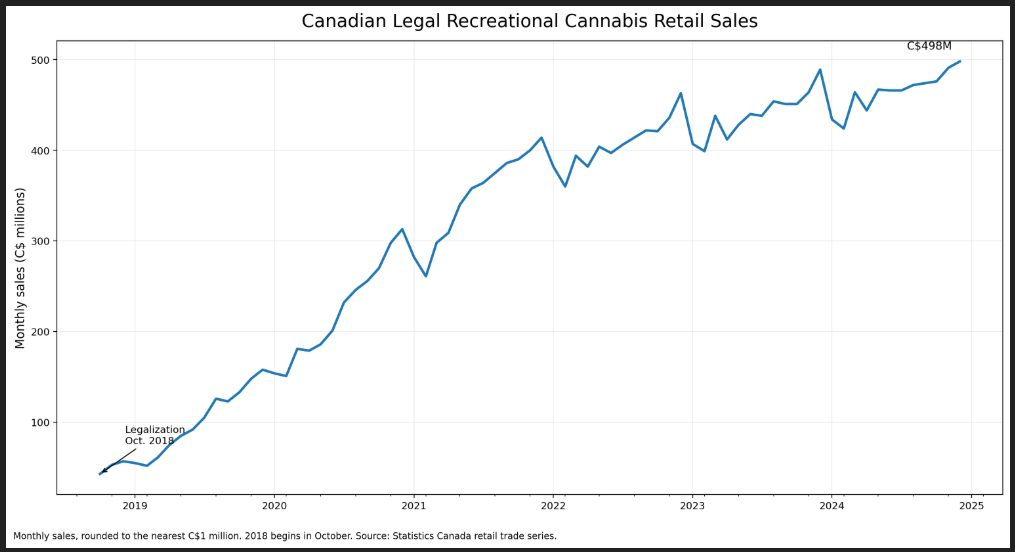
A meaningful amount of uneconomic capacity has been removed, and retail sales have continued to grow. As well, legal cannabis appears to be gradually taking a larger share of consumer spending.
During the early years of legalization, investors often treated cannabis as a commodity business. That is partly true, particularly for lower-end flower and bulk production. However, consumers have increasingly shown preferences for consistent products, recognizable brands, potency, convenience, and specific formats.
Prices remain competitive, but the most severe phase of wholesale price compression appears to have passed. Brand strength matters more than ever. The premium end of the market has not seen the same price compression as wholesale.
The barriers to entry have also increased. A new operator must navigate federal regulations, individual provincial purchasing systems, excise taxes, product listings, retail relationships, working-capital requirements, and a consumer market with many established brands.
International Market Opportunity
International cannabis has been promoted for years by many Canadian LPs, so investor skepticism is justified. Canadian investors have already watched domestic supply overwhelm demand and destroy pricing. It is reasonable to wonder why the same outcome will not eventually occur in Germany, Australia, Israel, the United Kingdom, or other emerging markets.
International sales also have potentially attractive economics. Cannabis exported legally from Canada can be removed as a non-duty-paid product and does not require a Canadian excise stamp. This avoids the domestic excise burden, which can consume a meaningful portion of a producer’s Canadian recreational revenue.
Exporting is not automatically more profitable. The producer still has to pay for certification, testing, freight and the local distributor. But removing Canadian excise from the equation gives them a pretty good head start.
I used to believe that price compression for internationally sold cannabis was a risk to the Canadian cannabis LPs. It prevented me from taking a position in several of them last year at far better prices. I have since changed my mind. To me, the international opportunity is different in three important ways: scale, cost, and regulatory experience.
Scale
Canada’s legal recreational cannabis market generated approximately C$5.5 billion in retail sales during the fiscal year from April 2024 through March 2025, up 6.1% year over year. Canada does not publish one official national retail-volume figure covering every cannabis format. However, Ontario reported approximately 441 million grams of cannabis sold in 2025 on C$2.28 billion of retail sales. Applying Ontario’s volume-to-revenue ratio to the national market suggests that Canada consumes approximately 1.0–1.1 billion grams, or 1,000–1,100 tonnes, of dried-cannabis-equivalent products annually.
International medical markets materially expand the addressable customer base. Germany alone imported approximately 200 tonnes of medical cannabis in 2025. Other markets, including the UK, Israel, Poland and Czechia, also rely to varying degrees on imported medical cannabis. Those five markets reported approximately 267 tonnes of combined medical cannabis imports during 2025.
A Canadian producer does not need to dominate these markets for international sales to become material. The sheer scale of the international opportunity will move the needle in a material way for the Canadian LPs.
There is of course the risk that other countries will produce locally, or other countries can ship to the new markets as they open up. But we have yet to see these countries embrace recreational cannabis and I think it’s inevitable that they do so. If Germany imported 200 tonnes of medical, what will they need for recreational use eventually?
Cost
The largest costs to operators are labour and electricity.
From a labor cost standpoint, Canada is probably neutral or potentially moderately disadvantaged to other countries. As is stands right now, Canada has amble unskilled and semi-skilled labour. Though the market may only tolerate minimum wage for such workers, there is a (real) chance that the province they work in will push minimum wage higher.
From an electricity supply standpoint, there are specific provinces with access to very reasonable priced electricity. Quebec, British Columbia and Ontario have access to cheap power. Cannara specifically calls out Quebec as a province that has cheap and reliable electricity.
The surviving Canadian operators have spent years navigating oversupply, price compression, facility closures and limited access to capital. Those conditions forced many of them to improve operating efficiency, focus on profitable products and become more disciplined about capital allocation.
Established producers may already have licensed facilities, experienced cultivation teams, quality-control systems and production infrastructure. For companies with suitable assets, expanding or modifying an existing facility can be less capital-intensive than building a new regulated operation from the ground up.
The main point on costs that I’m trying to make is that it needs to be understood on the margin. Canada has already cash flowing producers who can incrementally add capacity with minimal stumbling and new capital.
Regulation
Canada was one of the first major countries to legalize recreational cannabis nationally. Although its regulatory system remains complex (and overly clunky), the Canadian LPs have their share of battle scars.
Though this does not transfer automatically into every foreign market, it does help. European and other medical markets often require additional certifications, product registrations and local distribution relationships. Many Canadian LPs already possess EU-GMP capacity, export experience and relationships with end market suppliers in foreign countries.
International regulation will continue to move slowly. A headline about legalization or expanded access does not mean patients will immediately be buying Canadian cannabis. The advantage is that some Canadian LPs have already worked through these delays, found local partners and completed exports. They should make fewer mistakes the next time around.
The United States Is Optionality, Not the Thesis
I have no idea when the United States will legalize cannabis federally or permit normal cross-border activity. I do not want the basket to depend on predicting American politics.
Several Canadian companies have strategic investors, large cash balances, or relationships with tobacco and consumer-products companies. It is reasonable to think that American reform could eventually lead to mergers, acquisitions, or broader market access.
That would be meaningful upside, but it is not required for the thesis to work.
Why the Opportunity May Exist Now
There are several reasons cannabis valuations may remain disconnected from the underlying progress being made by some operators. I think there are a few reasons why there is a broad opportunity in Canadian cannabis companies.
Investor Trauma
First, investors remain focused on the industry’s history. Given the amount of capital destroyed, that is understandable. We have seen this play out before in other industries. People swore off certain markets or sectors due to prior poor performance.
Trading Political or Regulatory News
Second, many market participants use cannabis stocks as vehicles for trading political and regulatory news. They buy the sector when reform appears possible and sell it when timelines are delayed. That makes it difficult for slow operating improvements to receive much attention.
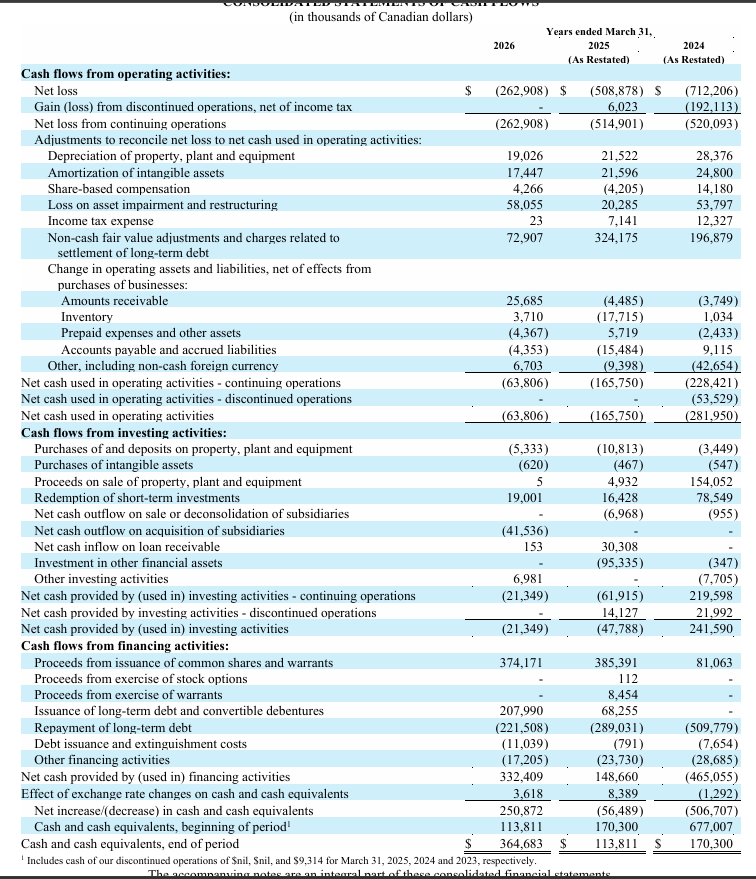
Financial Statements Are Clunky Using GAAP/IFRS
Third, the financial statements are (somewhat) difficult to analyze. Biological assets, fair-value adjustments, excise taxes, restructuring charges, and unusual inventory accounting can obscure the economics of the business.
Here is an example from Aurora Cannabis (ACB.to)
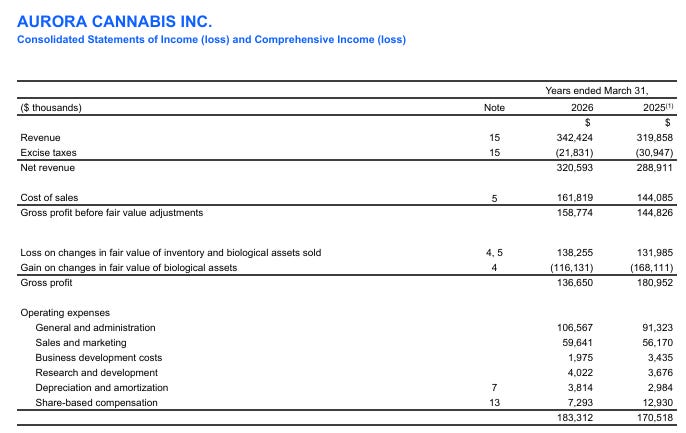
This is why I prefer to use the cash flow statement with an eye toward working capital turns or ratios.
The Industry Lacks Polish
Finally, much of the industry lacks polish. Investor presentations, disclosure practices, governance, and capital allocation are often below the standard institutional investors expect.
Could you imagine being a large mutual fund or pension fund and having to explain to Ethel or Ernest in their 80s that you see value in a company that produces the devil’s lettuce? Especially when some products have a 420:69 vibe to them.
Why Smaller Companies Interest Me
Some of the largest licensed producers still appear to be built around capital-market narratives rather than disciplined operating businesses. They raised enormous amounts of capital, accumulated complicated corporate structures, and expanded into multiple markets and product categories. Several have since rationalized costs, but many continue to under-earn relative to the capital invested in them.
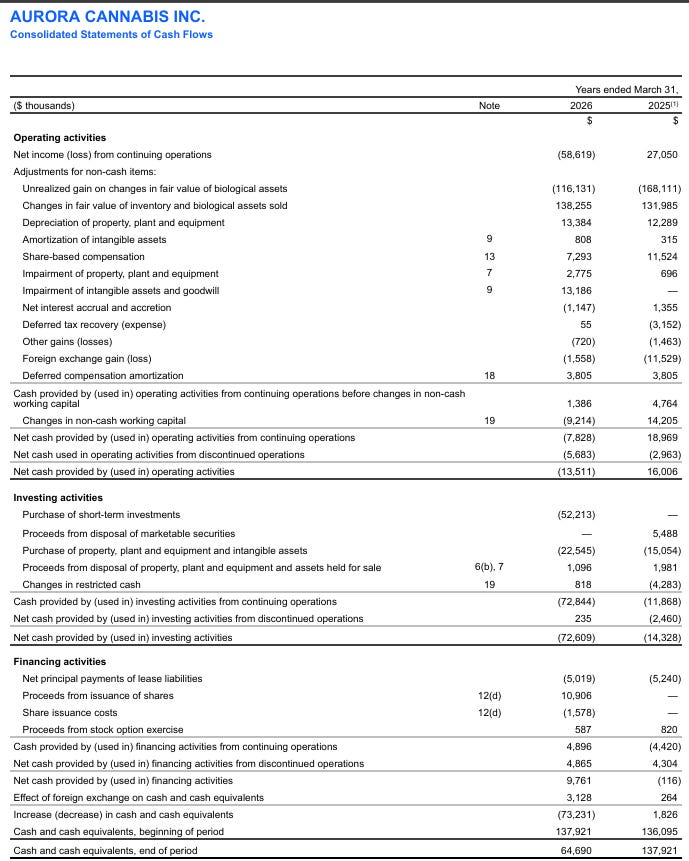
Look at the last year from Aurora, Canopy and Tilray:
Aurora - ACB.to
Canopy Growth - WEED
Tilray - TLRY
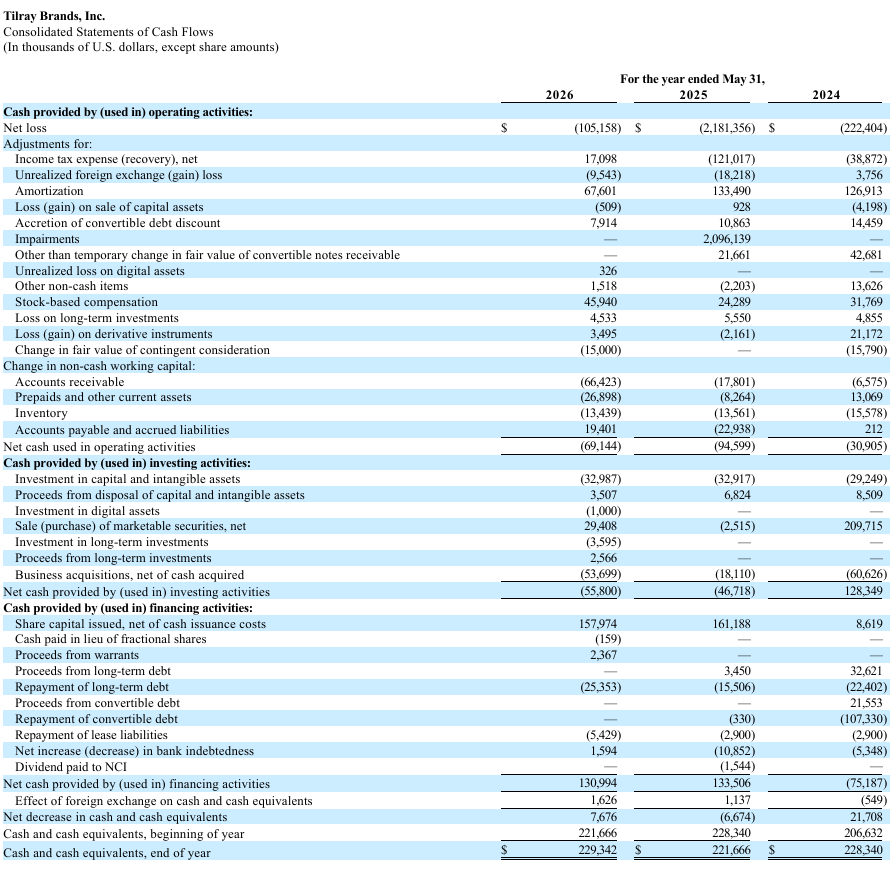
Here is my quick and dirty cash generated/consumed for 2025. I take CFFO - capex & intangible additions - lease and interest payments and I ignore working capital swings (I said it was quick and dirty):
Aurora Cannabis (ACB.to) -25 million
Canopy Growth Group (WEED.to) -108 million (-150 if you include acquisitions)
Tilray (TLRY.to) -18 million USD
Auxly Cannabis (XLY.to) +33.6 million
Decibel Cannabis (DB.to) +13.3 million
The market cap and enterprise value for each (pulled from TIKR in CAD):
ACB - 248/145 million
WEED - 557/470 million
TLRY - 541/688 million USD
XLY - 258/271 million
DB - 63/115 million
The smaller operators are where I see more potential value.
Many have already been forced to operate with limited access to capital. They could not repeatedly issue hundreds of millions of dollars in shares, so they had to become more tactical about inventory, production, facility expansion, and working capital.
That does not mean every small producer is well managed. Some still need to repair their balance sheets, simplify their share structures, or prove they can generate sustainable cash flow.
Why I Built My Own Basket
There are cannabis ETFs available, including products such as HMMJ, MSOS, YOLO, and MJ. The problem is that many of them contain a collection of companies I would not choose to own individually. Some are dominated by larger operators with weak operating histories, significant dilution risk, questionable balance sheets, or businesses that remain structurally unprofitable.
Buying the ETF may provide diversification, but diversification is not particularly valuable when much of the portfolio consists of companies I am actively trying to avoid.
By building the basket, I can own a combination of:
Companies with excess cash and strategic optionality
Strong consumer brands
Retail exposure
Smaller licensed producers with improving cash flow
Operators adding capacity in a measured way
Businesses with potential international growth
The Basket
It should be noted that I view all of the following as cash generating businesses. All have international revenue currently or in the very near future; some have been more meaningful that others.
Each has its own dynamic and I’m not sure which will work out the best, so I chose to build a basket. Currently XLY and DB are the largest holdings, but that could change. The total basket exposure is ~12% and I am looking to get it to 17-20% be end of year.
Cronos Group (CRON.to)
Cronos offers something rare in the cannabis industry: financial flexibility. The large cash position on the balance sheet gives them lots of opportunity. The current market cap is just over 1 billion, but the enterprise value is under 300 million.
Its cash position gives it the ability to continue investing in its brands, withstand difficult market conditions, and potentially participate in industry consolidation. The balance sheet reduces financing risk and provides optionality that most smaller producers do not have.
Having said that, it may have limited upside if they cannot deploy the excess cash at attractive ROIs. I view this as the safest bet I have in the basket.
Decibel Cannabis (DB.to)
Decibel has established brands and is pursuing measured capacity growth, but it also carries balance-sheet and share-structure risks. Both of which are solvable.
The company needs to demonstrate that additional production will generate cash and maintain their strong brand presence in key markets. Debt reduction, dilution, and capital discipline will remain important parts of the thesis.
They have the potential for meaningful international revenue moving forward.
Rubicon Organics (ROMJ.v)
Rubicon has built one of the stronger premium brand positions in Canadian cannabis.
Its current capacity investments may pressure near-term cash flow and increase execution risk. The attraction is that the spending is being directed toward a business with established demand rather than speculative capacity built ahead of the market.
The thesis now depends on whether the capacity additions will turn into meaningful free cash flow. This is the only position in the basket that the business hasn’t generated cash on a ttm basis due to the investment in expanding capacity.
Auxly Cannabis (XLY.to)
Auxly has made meaningful progress toward becoming a cash-generating operation. They have found a sweet spot with their brands and packaging. They have operated the facilities well through many cultivation and harvest cycles.
The share consolidation does not create economic value by itself, but a cleaner share structure combined with better operating performance may make the company easier for investors to evaluate.
The central question is how recent cash-flow improvements are used to further add shareholder value.
Cannara Biotech (LOVE.to)
Cannara has developed a strong presence in the Canadian market, particularly in Quebec, supported by recognizable brands and a large production platform. They have a strong brand recognition in the premium market.
The company is now adding capacity. This creates risk, but the expansion is much more measured than the uneconomic capacity building that characterized the early years. LOVE also has amble cash flow to finance the expansion.
LOVE is the only one where I don’t have any meaningful position, but I am looking to add.
High Tide (HITI.v)
High Tide provides exposure to Canadian cannabis retail rather than relying primarily on cultivation. They look to differentiate themselves from other retailers with a Costco like membership model.
Retail carries its own margin and competitive risks, but it reduces exposure to wholesale cannabis pricing. The company also has some international optionality and a platform that may benefit as the legal market continues to consolidate.
What Could Go Wrong
The major risks include:
Renewed price compression either domestically or internationally
Excise taxes remain burdensome
Capacity additions occurring ahead of demand leading to higher overhead
International markets developing more slowly than expected
New international supply compressing prices
International markets open up but utilize tariffs to increase the cost of Canadian cannabis
Provincial purchasing decisions disrupting individual brands
Management teams prioritizing growth over returns
It goes without saying that some of the companies will disappoint. I don’t know exactly how things will play out, so I have elected to build my own basket.
How I’m Grading My Execution
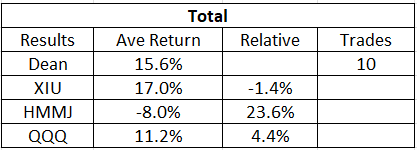
Similar to the OFS basket, the cannabis basket will be graded against the broader market and a relevant ETF on an absolute and relative basis.
Here is how my trades have performed so far. Keep in mind that I am still building the basket. I started building the basket in June 2025. So far, I have underperformed the XIU (TSX 60) and outperformed the Cannabis ETF and Nasdaq.
Closing Thoughts
The Canadian cannabis industry deserves much of its poor reputation. The industry had a ton of capital jammed down its throat. The focus on capacity additions in anticipation of demand that materialized much slower, led to a bloodbath. But the industry today is not the same industry investors funded in 2018.
The sector is still messy, but the businesses I own today look very different from the promotional vehicles investors funded in 2018. They have real brands, growing markets and, in most cases, actual cash flow. I do think that at some point this industry becomes investible for institutions and a major way.
I do not know which company will emerge as the clear winner. That is why I own the basket.
Thanks for reading my work
Dean
*long CRON, DB, ROMJ, XLY, HITI currently
Below are links to the original profiles for each company that I have profiled so far.


I'm a US taxpayer, so I focus on the cannabis REITs. They're better at dividends, and less subject to the boom-bust cycle problem.
Cheers, and good luck!
Excellent overview of the opportunity 👌🏼